

The Reichskolonialbund (RKB)
The The Reichskolonialbund (RKB), an attempt to rekindle a lost cause.
Since ships first sailed the seven seas, prominent European nations had tried to gain footholds in undeveloped countries for economic or strategic reasons. A few succeeded through amiable negotiations and land purchases from the tribal chieftains. However, as competition grew for land between the Europeans, brute force became the norm, with colonists exploiting the native populations, seizing precious metals or other treasures, and stripping the natural resources needed to feed the growing market, and fuel the constant conflicts which took place between monarchies. Spain, France, England, and the Netherlands were some of the first to vie for control of foreign lands, with stiff competition developing between them to see who would end up with the most valuable properties.
German merchants from the various Imperial states followed the same pattern by purchasing foreign lands from tribes, and buying and selling their wares to the inhabitants. Outposts were formed to replenish resource shortages in Germany, and to supplement the marketplace with new buyers when demand for goods in Europe fell off. In 1682, the German province of Brandenburg-Prussia established government-backed settlements in the current country of Ghana. These stations lasted until 1721 when they were relinquished to the French, who then gave them to the Netherlands.
For the next 150 years, German merchants continued to buy and sell their wares in small posts across the globe, during which time a few sundry attempts were made by German states to establish their own colonies overseas, but with little success. Also at that time, German missionaries joined settlements, endeavoring to spread the Christian Word among the heathen people. Following the coming together of the Imperial states under Otto Von Bismarck, the German merchants attempted to open larger colonies in Africa and Asia. Bismarck was reluctant to allow this as he did not want to cause ill will between the new Germany and the other established countries. But, by 1884, he changed direction and authorized merchants to proceed with their expansion. In addition, he sanctioned many governmental and military departments to start a period of Imperial colonialism, targeting much-needed natural resources, and establishing Germany as a world power.
When Germany claimed a new colony, initial negotiations with tribal leaders were again tried first. If these did not prove fruitful, areas were taken by force, with native inhabitants either subjugated by threats, or outrightly slaughtered for offering resistance. Colonies were founded in what is now the African countries of Burundi, Cameron, Namibia, Rwanda, Tanzania, Togo, Chad, the Central African Republic, Gabon, Ghana, Kenya, Mozambique, Nigeria, the Republic of the Congo and Uganda. Those not in Africa included German New Guinea, the Solomon Islands, North Mariana Island, the Marshall Islands, Samoa and parts of China.
Military and civilian administrators ruled with iron fists, operating as automatous “dictatorships”, lacking consistent communication with the outside world, and often left on their own. Force was always the primary driver, with well-trained and better armed troops being brought in from Germany or the adjacent colonies if necessary to smash any attempted uprising. Once administrators had gained control, they went about their intended business of extracting the land’s resources and using the natives as they saw fit. Major industries involved mining, timber and agricultural production that fed the growing European market, while indigenous people offered a market for excess German goods. Military installations protected the settlers from native uprising and incursions by other European forces when tensions between neighbors grew. These pockets of troops in the “Dark Continent” would a play vital part in battles later fought during the Great War’s African campaigns.
Following 30 years of conquest, constructive building and widespread exploitation, many of these far-off installations were abandoned as the Kaiser went to war in 1914. When the Central Powers capitulated to the Allies four years later, vengeful victors at the Treaty of Versailles in 1919 divvied up Germany’s remaining colonies as spoils of war, distributing them to Belgium, France, Portugal, South Africa and Great Britain.
After territory losses in Africa and the Far East, along with areas of the Fatherland being ceded to their adversaries, the pride of the German people took a devastating blow, compounded by the ridiculous economic burdens that were meted out in the treaty. Four years later, during the chaotic Weimar Republic, a number of nationalistic parties were formed by former colonists and their supporters. By 1925 the “Koloniale Reichsarbeitsgemeinschaft” (KORAG - Colonial Imperial Working Group) was founded as a national organization to work for the return of the Imperial German colonies. Though the group was never successful in reaching its goals, it was seen as a potentially effective source for propaganda and, with the NSDAP in power, was forcibly changed into an official organ of the Nazi party in 1936.
The newly named “Reichskolonialbund” (RKB- State Colonial League) provided another rallying point for Adolf Hitler’s National Socialist system, urging Germans to believe that they were victims of the “stab in the back” surrender in the Great War, causing the subsequent loss of their former overseas possessions. Soldiers who had served in those colonies, along with the administrators and their supporters, could join the league, which continued to stir up political frenzy in the crowds while preaching the Nazi’s agendas as the only way to solve their concerns. Newspapers, flyers, magazines, posters, radio coverage, meetings and mass rallies centered around the RKB revitalized a feeling of national pride and the longing for recolonization as part of “Lebensraum” (Living Space). As the Fuhrer was quoted, “The right to earth and soil can become a duty when a great people faces decline if it does not gain additional territory!”
The primary insignia of the RKB was the Peter’s Flag, honoring Dr. Carl Peters. Colonists venerated Peters as a great explorer, but his “Volkish” attitude of superiority led to the brutal treatment of natives. During his exploration days and as a territorial governor, he slaughtered entire villages if they threatened to rebel against his rule. Indigenous people gave Peters the nickname of “Mkono Wad damu” (the man with blood on his hands). In Germany, he was considered a hero, with streets named after him, a Kriegsmarine fleet tender christened the “Carl Peters”, and a propaganda film made in 1941 about his life’s story. The Peter’s flag emblem consisted of a shield-shaped badge featuring a black cross, overlaying a white background, with a red upper quarter containing five white stars.
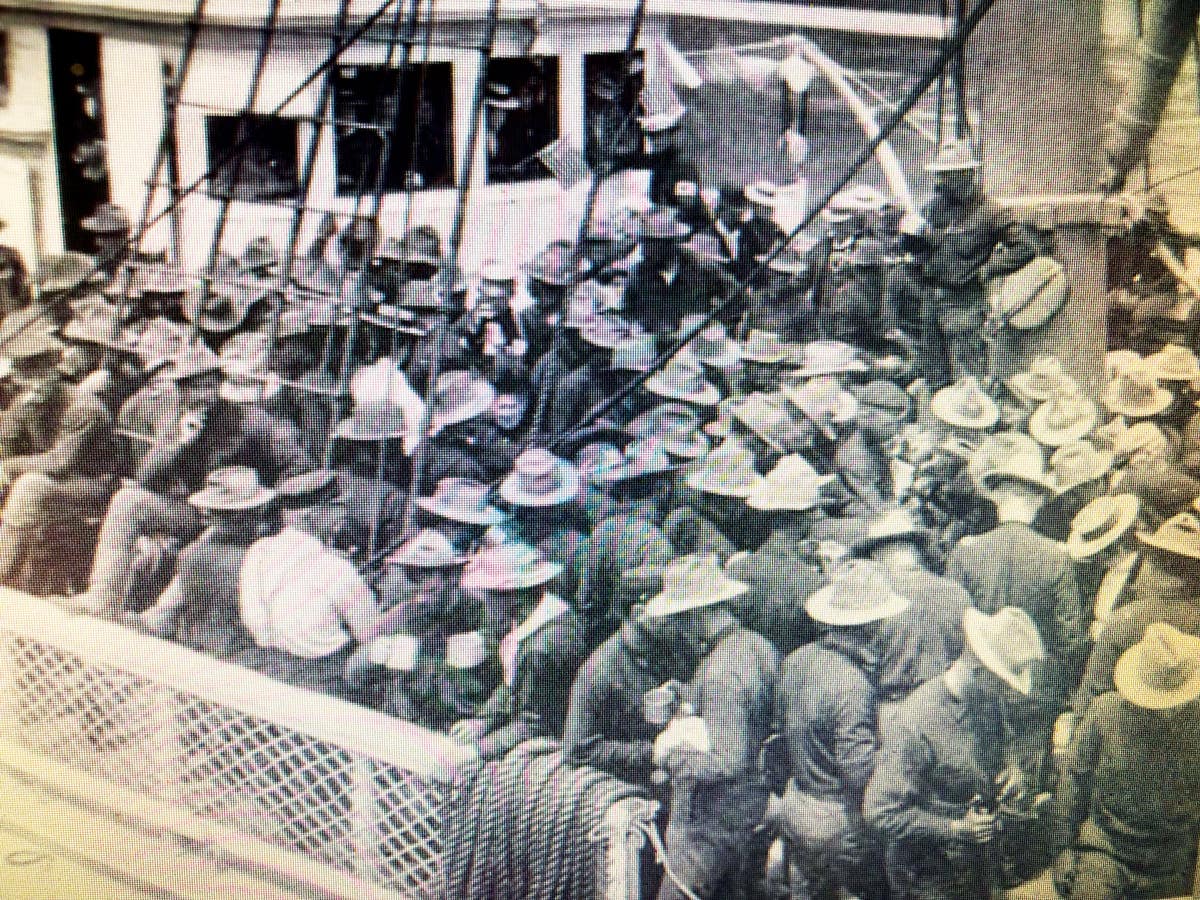
RKB military veterans’ uniforms were designed to copy those worn by German Imperial troops in the tropical climates. Men wore sand-colored four-pocket tunics with or without belts, matching trousers, and black shoes. On the tunic front were positioned any awards for valor or service that may have been won. A broad-brimmed hat witha turned-up edge attached to the body with a cockade topped the unique uniform, unlike any other worn in the Third Reich period. In 1938 the military veterans of the RKB were incorporated into the Nazi “Reichskriegerbund” (State Veterans League – RKB). Kriegerbund eagle and swastika badges were added to the members’ tunic breast pockets along with the standard NSDAP armband on their left sleeves.
Women could join the RKB Women’s Society, which sponsored the Rensburg Colonial School for Women. When first opened in 1926, the school taught women domestic skills and native customs needed when they returned to the former colonies. After coming under the control of the National Socialists, the school found difficulty in teaching its previous courses due to differences in racial and ethnic world views. Eventually, curriculum was changed to stress all things Germanic and Aryan, preparing students for the anticipated Lebensraum settlements in Eastern Europe.
Children could join the auxiliary of the RKB through the Colonial Youth group, then part of the Hitler Youth. These young boys and girls wore the uniforms of the Hitler Youth with the addition of RKB insignias while attending rallies and collecting funds for the parent organization.
The function of the RKB began to decline a few years after its first forming when the Nazi regime turned its attention to Lebensraum in Eastern Europe, rather than spending resources on its old Imperial colonies. Though greatly diminished in importance, the RKB continued on until 1943, when the concerns of the war and the failures in the East led Hitler to write a decree officially ending the organization.
https://www.collect.com/We know you love military history and vehicles, but do you collect anything else? Ever wonder about the baseball cards in a box in the basement or Grandma’s old coins in a jar? Do you love old cars or spin vinyl? Head on over to Collect.com and see what you are missing. Collect.com is the who, what, when and where of the collecting world! https://www.collect.com/

Chris William has been a long-time member of the collecting community, contributor to Military Trader, and author of the book, Third Reich Collectibles: Identification and Price Guide.
"I love to learn new facts about the world wars, and have had the good fortune to know many veterans and collectors over the years."
"Please keep their history alive to pass on to future generations".