

Reich Revolvers: The wheel guns of the Imperial German Army
While many other nations’ armies of the time carried double-action revolvers, produced domestically or purchased elsewhere, the Imperial commission chose the large single-action M79 instead.
The unification of the German states in 1871 under Otto von Bismarck marked a new page for the history of the Imperial armed forces. The handful of monarchies that had previously made up the German homeland each had their own standing armies with different sidearms ranging from percussion pistols to early cartridge models, many of which were single- shot weapons. In order to standardize the service sidearms of the new unified country, the “Gewehr-Prufungs-Kommission (G.P.K. — German Empire’s Rifle Testing Commission) tested and adopted the single-action, sturdy M1879 (M79) “Reichs revolver”.
While many other nations’ armies of the time carried double-action revolvers, produced domestically or purchased elsewhere, the Imperial commission chose the large single-action M79 instead. There were a number of reasons behind this selection of a fairly obsolete sidearm by the officers that made up the commission. At the time, they saw pistols as auxiliary arms with swords and sabers still used as the primary fighting weapons (for officers and soldiers issued sidearms). Secondly, because of the single-actions, combatants would fire ammunition less quickly, resulting in fewer rounds (weighing less) to be carried in the field. Finally, the simplicity of manufacture made the M79s more cost efficient, and faster to produce. All these factors made sense to the decision makers for a rapid program of rearmament following the new country’s combining of forces.
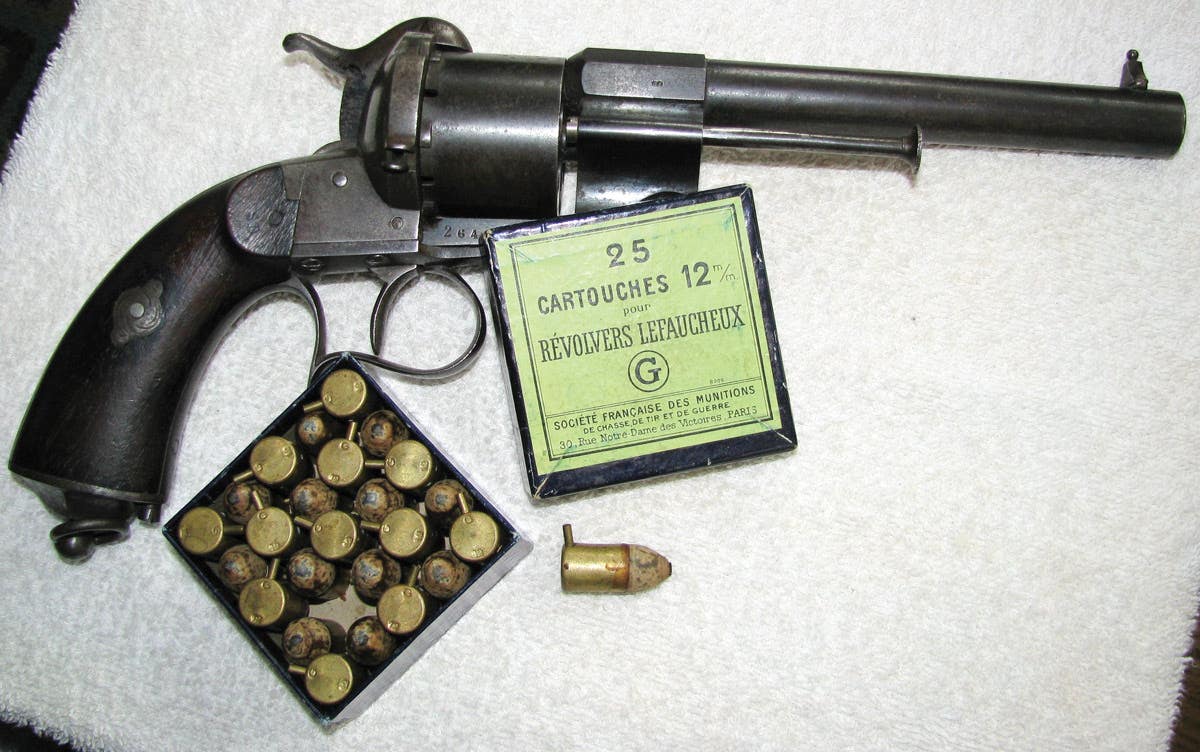
The M79 revolver was well made, rugged and simple to operate. At 12 1/8 inches long, this behemoth weighed in at 46 ounces, and fired a 10.6mm black powder round from its 7-inch barrel. Parts of the pistol were machined and heat treated to a degree that the they retained their precise functionality over time with little wear. However, that same extreme hardening process led to more instances where parts of the pistols fractured rather than simply wearing out.
The M79 barrel extended for 1 inch in a hexagonal shape from the frame with the remaining 6 inches rounded. The muzzle was surrounded by a band that provided additional barrel strength, with the end supporting a long blade front sight. The rear sight was a simple “V” cut milled into the rear top strap in front of the hammer. A unique feature of the revolver was the addition of a safety lever on the left side of the frame. Though somewhat cumbersome in use, this allowed the weapon to be carried at “half cock” to provide a level of security while the hammer was positioned over a live round. A more innovative feature was the recessed chambers on the cylinder that provided protection in the event of a blown cartridge.
A major drawback to the Reichs revolver was the lack of a better ejector system for removing empty cases. Wooden sticks were often carried in the holsters to poke spent shells out of each chamber. Another even slower, impractical and more laborious method was employed that required the bearer to turn out the cylinder pin retention screw, pull the pin out, remove the cylinder and use the pin to extract each casing.
The left side of the M83 frame is stamped with the Erfurt Arsenal designation, a date of 1896, military acceptance marks, and the serial number. Chris William
Despite this major drawback, the overall fit and finish was excellent, with all parts, including the screw heads and grips numbered to the individual gun. Manufacturers of the M79 service revolver included the German concerns of Spangenberg & Sauer, Suhl, J.P. Sauer & Sohn, Suhl, V. C. Schilling & C. G. Haenel, Suhl, F, Dreyse, Sommerda, and the Royal Arsenal, Erfurt. Manufacturers’ names are typically found in ovals stamped into the left side of the frames below the cylinders, accompanied by various military and inspector marks. Unit markings were usually found stamped (with older issuance marks crossed out) on the butt cap of the grip around the large lanyard ring swivel.
In 1883, the German Army improved the M79 Reich revolver by reducing the barrel to 4 3/4 inches, removing the ringed end, shortening the overall pistol length to 10 inches, and dropping the weight to 35 ounces. The grip shape of the new M83s was redesigned to be more rounded with the metal butt cap removed. The 10.6mm caliber remained the same as well, as did the outdated ejection system. To assist with the quicker removal of the cylinder, the side thumb screw was replaced with a spring button to retain the cylinder pin. Unit markings were typically stamped into the backstrap of the grip, with older marks “X-ed” over.
Both the M79 and M83 fired a uniquely constructed cartridge that had a “stepped” base on the casing. Loaded with black powder, the somewhat slow, but large 262-grain bullet traveled at about 700 feet per second, dealing a punishing blow to the unlucky enemy soldier that stood in its path.
The M79s were housed in long cowhide holsters with roller buckle straps to keep the hardshell covers closed, and double belt loops attached to the reverse. The shorter M83s were carried in holsters with a wide leather strap that crossed horizontally over the grip and was secured to a metal post on the rear edge. The second model had an ammunition pouch containing individual shell loops and a flap cover secured with a strap buckled to the lower side. Both early and later holsters contained pressed and ink stampings of maker names, dates of manufacture and unit markings.
M83 Reichs revolvers (predominantly those purchased by officers or sold on the commercial market) could be privately ordered with a variety of non-standard features. Customized examples were often produced in double-action, rather than the slower single-action. Other variations included checkered wooden grips, finger rests on the trigger guards, spring-loaded ejector systems, and double-trigger, “cock and release” designs.
By 1908, the M79 and M83 were replaced as the standard weapon of the Imperial army with the introduction of the 08 Luger pistol. Even after the modern semi-automatic sidearms took their place, M79s and M83s continued to see use with secondary military units, police forces and German colonial troops up to and including the Second World War.
Reflecting a bygone era, Reichs revolvers remind us of a time of simple design, elegance and craftsmanship: a period when the horrific carnage of battle was colored over by a more romantic view of chivalry and honor.
Chris William

Chris William has been a long-time member of the collecting community, contributor to Military Trader, and author of the book, Third Reich Collectibles: Identification and Price Guide.
"I love to learn new facts about the world wars, and have had the good fortune to know many veterans and collectors over the years."
"Please keep their history alive to pass on to future generations".