

Mussolini’s prized Marshal of the Empire hat crowns Milestone’s April 18 Premier Military & Edged Weapons Auction saluting 250 years of American military might
723-lot selection of World War II Axis relics and articles of memorabilia up for sale at Milestone Auctions April 18 Premier Military and Edged Weapons Auction.
WILLOUGHBY, Ohio – The United States will celebrate its 250th anniversary on July 4th, but Milestone Auctions is getting the party started early on April 18 with a Premier Military & Edged Weapons Sale that salutes our armed forces from the American Revolution through modern times. The 723-lot selection includes uniforms, helmets and headgear; medals, flags, insignia, photos, and hundreds of Nazi, Japanese and other World War II Axis relics and articles of memorabilia, including German and Japanese “Big Eye” binoculars and a cased Japanese machine gun aviation camera. The huge array of edged weapons runs the gamut from swords, knives, katanas and daggers to a bone-chilling circa-1700 executioner’s sword previously held in the Torture Chamber Collection of Nuremberg, Germany.
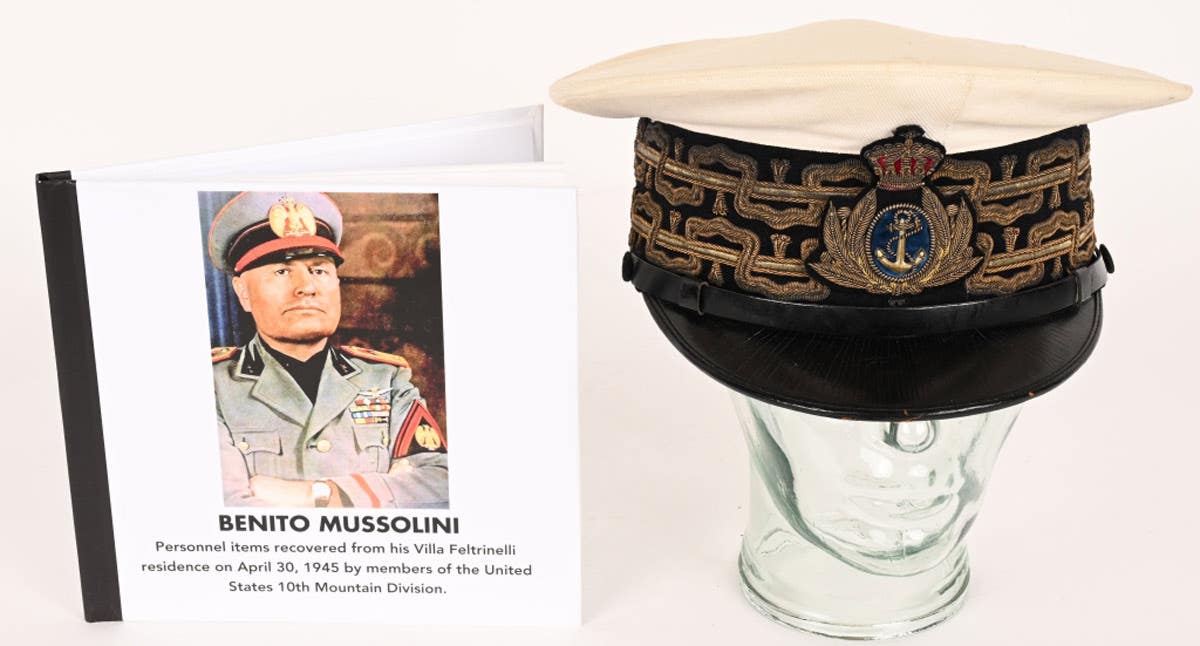
One of the most infamous characters of World War II was fascist dictator Benito Mussolini, who proudly assumed the honorary title of Marshal of the Empire following Italy’s imperial ventures into Africa. To reflect the grandiose, self-styled military designation he introduced in 1938, Mussolini adopted a new accessory to denote his heightened status: a grand visor hat decorated with regalia exclusive to the highest military command. That very hat – looking as new as the day it was first donned – is a top highlight of the April 18 auction.
The peaked hat’s band is richly embellished with gold braid, symbolizing naval authority and martial prestige. The central insignia is hand-embroidered in gold bullion and features a crowned anchor flanked by laurel leaves. The interior is lined in silk with a white leather sweatband emblazoned with the gilded initials “B M.” It bears the (partially-visible) original triple-crowned maker’s mark “Carozzolo,” consistent with the documented Italian military tailors of the period. This hat is not only a significant WWII military artifact but also a poignant emblem of Mussolini’s doomed regime and the fascist aesthetics they embraced during the interwar period.
“Any articles having a direct association with Mussolini, especially official items of rank, are exceedingly scarce and highly sought after by collectors of WWII memorabilia, general militaria, and 20th-century political history,” said Miles King, co-owner and principal auctioneer of Milestone Auctions. “The peaked cap was among the items recovered from Mussolini’s villa in 1945 by members of the US 85th Regiment, 10th Mountain Division.” Specifically, the cap was souvenired by Major Erick Wikner of that regiment and division.
A WWII Nazi Luftwaffe M38 Fallschirmjager paratrooper’s helmet of stamped sheet-steel construction exemplifies the “second pattern” design that superseded the original design to resolve safety concerns. The helmet’s updated form was intentionally rimless as a precaution against neck injuries that might be incurred during parachute jumps. The auction example retains most of its original green/gray paint with traces of white camo paint. To its side, a spread-winged National Eagle holds a canted swastika decal with approximately 85% of its finish intact. It is marked with a faintly stamped serial/lot number “4986" and the code "ET 66,” indicating its manufacturer to be Eisen-und Hüttenwerke, AG Thale/Harz and its size to be 66. The interior has a brown leather liner to which a St Christopher Medal is attached. The helmet’s style was introduced in June 1938 and remained in use until the end of the war, with minor variations.
In line with Nazi officers’ well-known obsession with appearance, a WWII German general’s Panzer assault gun wrapper uniform was expertly tailored by Nikolaus Fanroth of Frankfurt, and accessorized with an M43 cap. A first pattern design (circa 1940-1942), the uniform is composed of field gray wool and a rayon blend fabric. The waist-length, double-breasted-style tunic has small fold-back lapels and a large lay-down collar. The right breast is adorned with a hand-embroidered National Eagle with outstretched wings, clutching a wreathed, canted swastika in its talons. The labor-intensive gilt bullion and golden-thread handwork is of the highest quality, as would be expected of any apparel intended for a general. The shoulders display a beautiful set of post-July 1938 general major shoulder straps with interwoven strands of Russian braiding with a central silver/aluminum braid flanked by dual golden yellow celleon braids, all mounted on a red wool base. The collar features hand-embroidered Arabesque-style “Larisch” pattern ornamentation in bright, gilt-wire threads. The cap is machine embroidered with silver bullion wire, with the National Eagle machine-stitched to the cap.
A WWI Imperial German general’s tschapka is from the 2nd Garde Uhlan (Lancer) Regiment, which was part of the Guards Cavalry Division that fought on the Western Front. After the war, the regiment was honored with a memorial to its fallen soldiers in the island neighborhood of Moabit in Berlin. (A detailed account of this especially-active regiment’s wartime operations is included in the auction lot’s description in Milestone’s catalog.) A fine example of distinctive lancer regiment headgear, it has a leather body with a brass Garde Regiment helmet plate adorned by an enamel starburst center. Also, it has brass scaled officer’s pattern chinstraps with a single officer’s Reich’s cockade.
With the advanced technologies available to Western armed forces of today, it is nothing short of remarkable that distant enemy aircraft of World War II could be identified using only a pair of binoculars. However, not all binoculars of that period were “created equal.” One of the auction’s top highlights is a pair of WWII Nazi Doppelfernrohr 10 x 80 20-degree KM binoculars made by Optische Praezisions-Werke of Warsaw (under license to Zeiss), representing the highest level of European optical technology of its day. Made around 1943, this perfected version of its 1940 predecessor was made expressly for anti-aircraft batteries installed on Kriegsmarine warships. Its optics allowed the user to identify enemy aircraft in the distance quickly and with great precision. The binoculars to be auctioned are equipped with a mechanism for inserting two filters (one orange and one dark gray), enabling vision both in the daytime and when light conditions are poor. It is presented in its original case of issue.
The auction also includes a pair of WWII Imperial Japanese Navy 20 x120 3-degree “Big Eye” binoculars made by Tokyo Optical Company (Toko/Tokyo Kogaku Kikay) and serial numbered “189.” They are of a type that was mounted on battleships, destroyers and cruisers. Toko was known for its large-aperture binoculars like the 20 x 120, which were designed to funnel in as much light as possible for spotting ships from a distance. The auction binoculars also bear the name of the veteran who souvenired them: CAPT. M. M. RIKER COM PHIB PAC.
A WWII Nazi German period poster illustrates the danger of nighttime raids through chilling graphics and a stern warning. The art features a menacing skeleton hurling a bomb from atop a British bomber as the plane attacks a house with its lights on. The German text reads “Der Feind sieht Dein Licht! Verdunkeln!” (Blackout! The enemy sees your lights!). Printed by DPA Sander Herweg, this beautifully framed poster’s dimensions are 33 inches by 47 inches.
Perhaps the most extraordinary entry in the Edged Weapons category is an extremely rare and fine-quality German executioner's beheading sword dating to around 1700. It has a 33-inch blade, a bronze hilt with a straight square section crossguard, and a faceted globe pommel. The terrifying weapon was actually used by the Executioner of Augsberg and was previously held in the Torture Chamber Collection of Nuremberg. It also appears as Figure 82 in the Claude Bair reference book European & American Arms.
Milestone’s April 18, 2026 Premier Military & Edged Weapons Auction will be held live at Milestone’s gallery located at 38198 Willoughby Parkway, Willoughby (suburban Cleveland), OH 44094. Start time: 10 a.m. ET. All forms of bidding will be available, including live via the Internet through Milestone’s own bidding platform, LiveAuctioneers, Invaluable or AuctionZip. For additional information on any item in the auction, call 440-527-8060 or email info@milestoneauctions.com. Online: www.milestoneauctions.com
We know you love military history and vehicles, but do you collect anything else? Ever wonder about the baseball cards in a box in the basement or Grandma’s old coins in a jar? Do you love old cars or spin vinyl? Head on over to Collect.com and see what you are missing. Collect.com is the who, what, when and where of the collecting world! https://www.collect.com/

Established in 1993, Military Trader is dedicated to the collecting preservation, restoration, study, and display of historic military artifacts. Spanning interests from military uniforms to medals, or helmets to ordnance and weapons, Military Trader is your best source for in-depth techincal articles, artifact profiles, product and hobby news, current values, and show and auctions calendar.