

Flying High: A military history weekend at the Helicopter Museum
The Helicopter Museum (www.helimuseum.com), located on the Locking Road (A371) between Weston-super-Mare and Banwell in Somerset, England, is one of these specialist museums and hosts an annual military history event.
This one found a home at the Helicopter Museum in Somerset, England. John Norris
There are plenty of museums around the world, from local town museums to big national shrines, which have earned international recognition. Some of these museums focus on diverse themes, while others concentrate on one specific subject such as aircraft or submarines. Many have had to evolve with the times and incorporate modern technology into their exhibitions with short informative films and interactive displays. Many now have annual calendars of special events to provide visitors with added attractions throughout the year.
Those having collections which focus wholly or partially on military themes are often able to host their special weekends on site, to which they invite military re-enactment groups and historic vehicle owners. Attendees can set up small outdoor encampments and displays of their collections that serve as an extension to the museum’s displays.
The Helicopter Museum (www.helimuseum.com), located on the Locking Road (A371) between Weston-super-Mare and Banwell in Somerset, England, is one of these specialist museums and hosts an annual military history event in spring which attracts good crowds.
The origin of the museum can be traced back to 1958 when Elfan Ap Rees, an aviation enthusiast, author and collector, started to acquire various items connected to helicopters. Over the next 20 years this collection expanded to include airframes and even entire machines such as a Westland “Whirlwind” and a Bristol “‘Belvedere”. In 1978, Ap Rees acquired some property and built a small building for his collection that continued to grow and eventually included Russian, American, French, Italian and German aircraft.
Today the museum features more than 80 machines, both civilian and military types, all under one roof. There are familiar and the not-so-familiar designs, some of which have served in conflicts such as Vietnam, Falklands and Northern Ireland, and examples of Russian types as flown in Afghanistan. The museum has its own dedicated workshop area with heavy lift arrangements to undertake restoration projects on site. There are outdoor exhibits such as a “Bloodhound” anti-aircraft missile which can be seen by motorists as they drive past and which has become something of a local landmark.
The groups taking part in this year’s Military History Weekend included re-enactment troops, local plastic modeling clubs and collectors. There were a few traders, and local history groups presented a fascinating display of operational wartime airfields in the area, including the site on which the Helicopter Museum was built. The layout had been arranged in such a way that the indoor traders and modelers displays were incorporated to become almost part of the exhibition and complimented the overall theme. The local historians were amiable and related incredible wartime events connected to the site, which was a training ground from where Spitfires and Beaufighter aircraft flew operations.
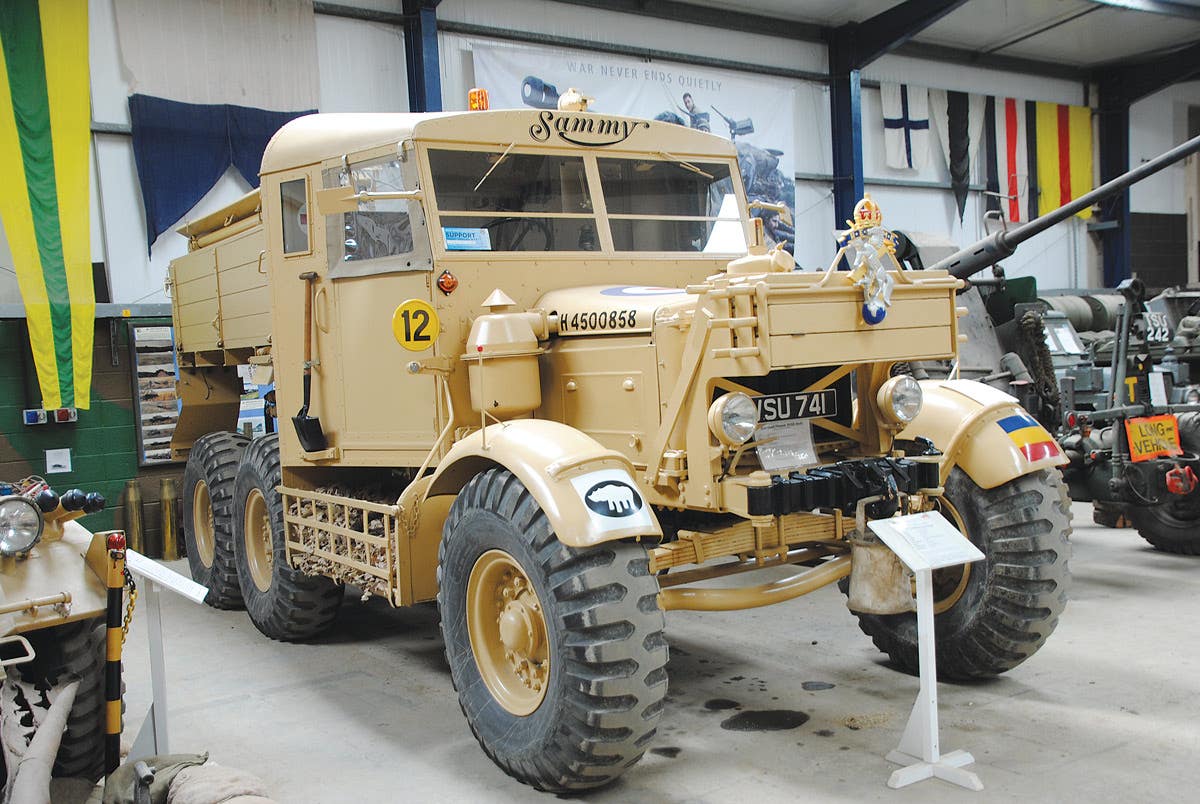
Due to restricted space and room to maneuver on site, the museum vehicles remain static, but still attract a lot of attention. A couple are very unusual, such as the 1949 Ferguson TED tractor used by the Royal Air Force, displayed complete with an information board. Also, the last-known example of a Morris Commercial CS11/30F ambulance stands alongside a former French army Renault ambulance. One of the stars of this year’s show was an AMX-13 light tank brought to the event by the French Army Re-enactment Group. There were the usual Jeeps and motorbikes to support the display of collections by groups, along with weapons by the score.
One group depicting a WWII German Army unit had bicycles incorporated into their display with items draped on them to create a free-standing exhibition. A small British Home Guard display stood along with other groups showing U.S. Navy equipment and the 29th Infantry Division to commemorate the landings on Omaha Beach. The Vietnam period was covered by a group depicting the 173rd Airborne Brigade, nicknamed “The Herd”, with weapons, kit and equipment in the collection.
The show and the Helicopter Museum made for a great pairing for visitors, who were treated to an all-round experience. All interests were covered, from model makers, who used it as a reference source for future projects and dioramas, to military enthusiasts and collectors. Even those with only a passing general interest probably enjoyed all the history, vehicles and artifacts on hand.
The success of the weekend can be gauged by the fact that visitors rate it one the best shows in the museum’s annual calendar of special events. It is a trend that seems likely to continue.
one of which was this emblematic helmet with the unit’s shoulder patch. John Norris

Established in 1993, Military Trader is dedicated to the collecting preservation, restoration, study, and display of historic military artifacts. Spanning interests from military uniforms to medals, or helmets to ordnance and weapons, Military Trader is your best source for in-depth techincal articles, artifact profiles, product and hobby news, current values, and show and auctions calendar.